


Six Ways to Lower Rising Health Costs for Companies
Read more

As you build this year's recommendations, the riskiest move isn't recommending the wrong thing — it's leaving navigation off long enough for a competing advisor to recommend it instead. Here's the behavioral science, ROI math, and stewardship-report case behind why waiting a year costs your client more than they think, and costs you the credit.
A quick note before you dig in: if you're already evaluating a specific partner rather than weighing whether to act at all, you may want to check out our "8 Questions Every Broker Should Ask Before Recommending a Cost-Containment Partner."

You're probably already ranking your shortlist for this renewal cycle. The question worth sitting with: if you don't put navigation on it, will your client hear about it from someone who did?
According to 6sense's 2025 Buyer Experience Report, 94% of buying groups rank their shortlist in order of preference before they ever contact a seller — and they go with whoever they talk to first roughly 80% of the time. Translate that to your world: your client isn't debating whether their employees need help navigating a fragmented benefits system. They're drowning in a system nobody taught them to use, and every advisor in the market knows it. The only open question is whose name is attached to the fix. If it isn't on your list this cycle, it'll be on someone else's — and it'll be their stewardship report, not yours, that gets to claim the win.
Benefits advisors have always managed cost. What's changed is that doing it well or poorly now shows up directly in whether they keep the client. Premiums hitting record highs, CFOs sitting in on renewal conversations they used to skip, employers openly comparing notes on who's actually containing spend vs. who's just explaining it — this used to be a line item you could manage quietly. It isn't anymore.
That's the backdrop for why the "we'll communicate it better" fix doesn't hold up the way it used to — and why the actual fix has to be something different.

Here's the trap you've probably watched a hundred times: a client adds a good benefit, nobody uses it, and the reflex — from the client, sometimes from the incumbent broker — is "we need to communicate it better." Another email. Another webinar. A thicker open-enrollment packet.
That treats the symptom. The real issue is behavior design, and understanding why matters because it's the argument that holds up when a client pushes back.
Medefy's Proprietary Behavior Change Model boils behavior change down to a simple formula: a behavior happens when motivation, ability, and a prompt converge at the same moment. Miss any one of the three and nothing happens, no matter how much information is sitting in a portal that nobody opens.
You already live inside this model. You leave something in your online shopping cart, then you get a nudge on Friday morning: "Forgot something? Complete your checkout." Motivation is high, the prompt lands at the right second, and a biometric tap removes all friction. You buy.
Medefy runs the same playbook on healthcare decisions — decisions with far higher stakes than an impulse buy. And the results validate the theory: 94% of members take the recommended action when the moment of decision is met with the right guidance. That's not a talking point. It's the number that makes this defensible to a CFO, and it's the number worth putting at the top of your next stewardship report with your name next to it.
Most vendors solve one piece of this. Medefy is built across all three.
A portal for members. An analytics report for the broker. A communications push for HR. Most of what's on the market solves one slice of the problem and leaves the other two parties to fend for themselves — which is exactly why so many point solutions get bought, ignored, and replaced a year later.
Medefy is built to work across all three groups at once — broker, HR, and member — because that's where the actual leverage is. A plan only performs the way it was designed when the person who designed it, the team communicating it, and the people using it are all pulling in the same direction.
One front door for ID cards, plan details, virtual care, and every point solution your client already bought. Not another login. The one login.
A multi-channel engagement engine — text, email, app push, even physical mail — built around consumer behavior, executing your strategy. You set the goals; Medefy pulls the lever.
When a member is actually facing a choice — which provider, which facility, which next step — that's the moment behavior either changes or it doesn't. Medefy is built to be present in that moment, consistently, in a way that produces the 94% number above instead of the sub-10% outcome that happens when members are left to figure it out alone.
The strategy stays yours. Medefy is what makes the plan you designed actually perform the way you designed it.
This isn't just about your client. It's about your practice.
Every one of those three things solves a problem that currently lands on your desk, directly — not by way of HR, not by way of the member.
If you've been burned before by a vendor that promised engagement and delivered a portal nobody opened, that history is worth naming out loud with your client. Most of those tools failed because they only worked for the member. This one is built to work for all three of you at once.
This is the part that should make "let's revisit next year" feel expensive to say out loud.
A year of delay isn't a postponed start — it's a forfeited year of savings, gone rather than banked. Adoption compounds: members who engage early become habitual users who generate returns every year after. Wait a year, and the curve doesn't just shift right — its most valuable early stretch disappears entirely.
Made concrete: a 500-employee, self-funded group, modeled conservatively at 30% adoption, could see roughly $112K in gross year-one savings against about $29K in platform cost — call it $84K net, a ~2.9x return, with payback near nine months. That example is intentionally conservative and sits below Medefy's average client ROI of about 3.5x (with top performers reaching 9–11x) — the point isn't that this is the ceiling, it's that even a cautious estimate makes waiting the expensive choice. Every group is different, but the logic holds regardless of size.
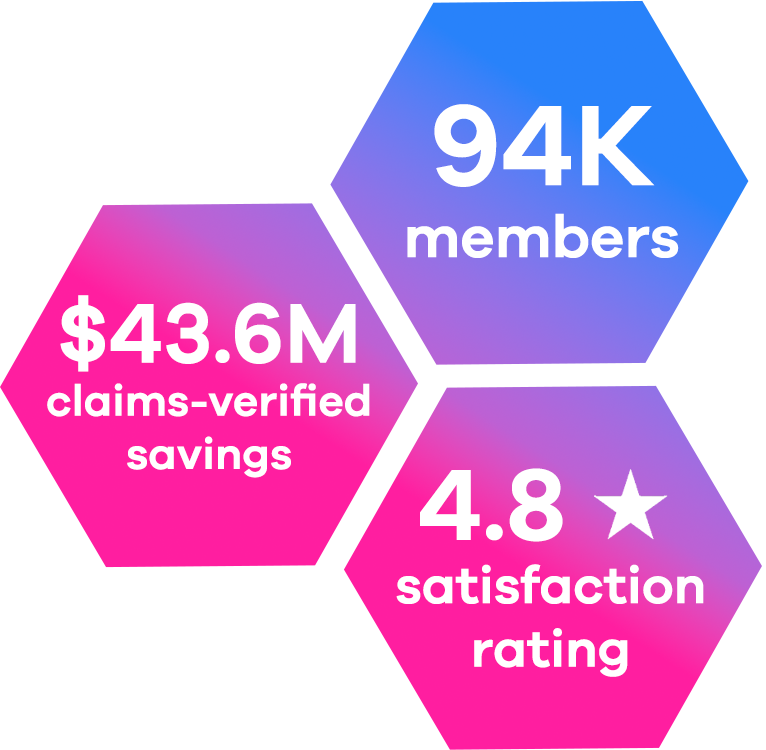
And it scales. The State of Oklahoma Employee Health Plan — 94,000+ members, every dollar scrutinized in public, savings validated against actual claims — has generated $43.6M in claims-verified savings over five years, with 66% adoption, 79,495 procedures redirected to lower-cost providers, and member satisfaction climbing from 1.6 to 4.8 stars. One member, describing a colonoscopy he'd been dreading the cost of, found he could get it done at a shared-savings facility for free instead of paying a hospital copay. That's the 94% stat showing up as a single, specific decision — the kind of story that makes the number believable instead of abstract.
That's what compounding looks like when a client starts now instead of "next year."
For qualified groups — right size, self-funded — Medefy puts its own fees at risk behind a performance guarantee, written into the contract. If the savings goals aren't hit, that's on Medefy to make right.
That's the detail that changes the conversation with a hesitant client. You're not asking them to gamble on a projection. You're handing them a decision where the savings don't pause while they deliberate, and the downside is capped before they sign anything. That's what turns "let's wait until next year" into "why wouldn't we deploy this now?" — and it's the kind of recommendation a client remembers at the next renewal.
Your client's CFO is going to ask about AI. Here's your answer.
They will ask — "why can't we just use AI for this?" — and how you answer matters more than most brokers realize. As one broker with a decade of care-navigation experience put it in a recent conversation: everybody's talking about AI right now, and leading with that claim in front of a client is genuinely risky, because every vendor is "using AI" a little differently, and simply saying so isn't a differentiator anymore.
The honest answer: a bot can answer a question. It can't change behavior at scale. Medefy uses AI to sharpen how it works — but the differentiator is the data and the consistency of what happens when a member is actually facing a decision, not a claim about AI on its own. Lead with that, and you've got an answer no competing advisor in the room is bringing.
Don't pitch off the figures above. Give us a group size, and we'll show you what the savings opportunity could look like for that specific group — using the case studies most relevant to your book of business, so you can pressure-test every claim against deals that actually resemble yours.
You make the intro. Medefy does the analysis and the pitch. You stay in the driver's seat.
There's no risk to your client in finding out what the number is. The only thing that isn't free is another year of waiting.
Before you finalize this year's cost-containment recommendation, make sure you're asking the right questions of any partner in the running. Check out our "8 Questions Every Broker Should Ask Before Recommending a Cost-Containment Partner" to pressure-test the field before you put your name on a decision.


