


Six Ways to Lower Rising Health Costs for Companies
Read more

Members don't ignore great benefits because they don't care. They ignore them because they have just not been properly conditioned on how to understand and use them.
There's a familiar conversation happening in HR offices across the country: "We added a new high-value benefit last year. How come no one used it?" Their instinct is to blame the benefit — wrong fit, too expensive; employees just don’t need it. But what if the benefit was fine all along, and the real gap was how —and how consistently — employees were guided toward it?
That's the central insight the Fogg Behavior Model offers HR leaders and benefits advisors. And it's one we've watched play out in our member engagement data in a way that's hard to argue with.
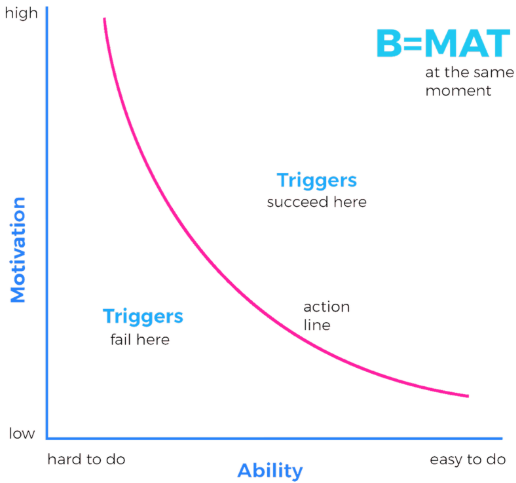
Dr. BJ Fogg of Stanford's Behavior Design Lab distills human behavior into three variables:
B = MAP: Behavior happens when Motivation, Ability, and a Prompt converge at the same moment.
Miss any one, and the behavior — the referral, the appointment, the Care Guide conversation — doesn't happen.
Motivation is largely outside an employer's control. People are motivated when something is personally relevant: a new diagnosis, a family health scare, a large medical bill. It spikes unpredictably.
Ability is where benefits programs most often fail passively. Insurance is complicated by design — networks, prior authorizations, and deductibles. That complexity reduces a member's ability to act even when motivation is high. Simplifying navigation builds ability before a need arises.
Prompt is the trigger — the thing that shows up at the right moment and says, "now is the time to act." A benefits guide handed out at open enrollment isn't a prompt; it's a document. A well-timed push notification tied to a member's likely need is a prompt. This is where most engagement strategies fall apart, and where the data tells the clearest story.
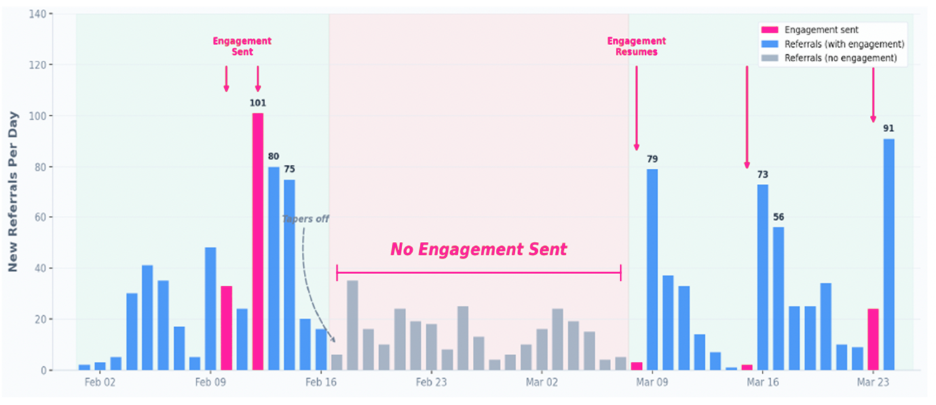
One Medefy client decided to suspend all member outreach for approximately five weeks. No emails, no app notifications, no Care Guide touchpoints. What happened is a near-perfect illustration of the Fogg model.
During the active engagement period, new referrals climbed to over 100 per day, directly correlated with when outreach was sent. Then outreach stopped. Referrals faded to 5–25 per day — not a cliff, but a slow, sustained drain. Members lost the prompt that was creating the moment of convergence.
Then, when the client resumed engagement, referrals rebounded to 79 per day within days and reached 91 per day within two weeks.
Nothing changed except the presence of a consistent, intelligent prompt. That's the model in action at scale.

Here's how high-performing HR teams build engagement that doesn't just spike at open enrollment and fade by December.
The utilization gap that your clients are experiencing is almost certainly an engagement architecture gap. Here are the diagnostic questions worth asking:
Benefits programs that communicate once a year are not neutral — they're actively creating the conditions for disengagement. The Fogg model is unforgiving: absent the prompt, the behavior won't happen, even when motivation and ability are adequate.
The case study above wasn't about a bad benefits program. It was about what happens when a good program loses its drive. The referrals stopped because the system that created the conditions for behavior change went quiet.
When that engine turned back on, so did the behavior. That's the mechanism by which everything else works.
Medefy is a benefits navigation platform built around the idea that engagement and guidance — not just access — determine whether benefits deliver on their promise.


